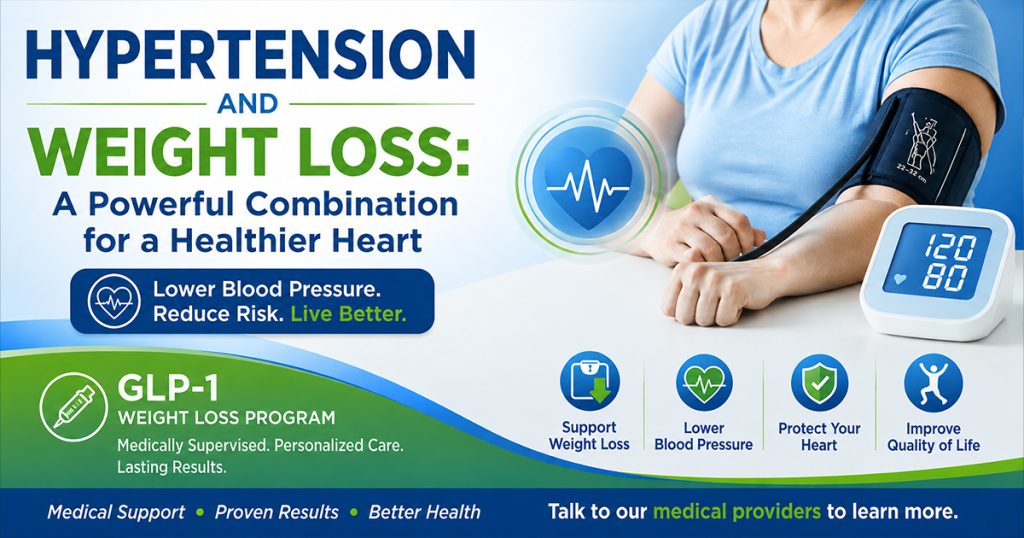
High blood pressure, also known as hypertension, is one of the most common chronic health conditions in the United States. Because it often develops without obvious symptoms, many people may have high blood pressure for years without realizing it.
Over time, uncontrolled hypertension can place significant strain on the heart and blood vessels and increase the risk of heart disease, stroke, kidney disease, and other serious health problems.
For people who are overweight or living with obesity, there is another important connection to consider: body weight and blood pressure are closely linked. Losing excess weight may help lower blood pressure and improve overall cardiovascular and metabolic health.
For some patients, medically supervised weight management—including GLP-1-based treatment when clinically appropriate—may provide additional support in achieving meaningful and sustainable weight loss.
Blood pressure measures the force of blood pushing against the walls of your arteries as your heart circulates blood throughout your body. A blood-pressure reading contains two numbers:
According to the 2025 American Heart Association/American College of Cardiology guideline, normal blood pressure is below 120/80 mm Hg. Stage 1 hypertension is generally defined as systolic blood pressure of 130–139 mm Hg or diastolic pressure of 80–89 mm Hg. Stage 2 hypertension begins at 140/90 mm Hg or higher.
Hypertension is frequently called a “silent” condition because it may cause no noticeable symptoms. Regular blood-pressure checks are therefore important, particularly for people who have additional cardiovascular risk factors.
When hypertension remains uncontrolled, it can increase the risk of:
Excess body weight can affect blood pressure in several ways.
A larger body requires the heart to circulate blood through more tissue, increasing the demands placed on the cardiovascular system. Obesity is also associated with hormonal, metabolic, inflammatory, nervous-system, and kidney changes that can contribute to elevated blood pressure.
This relationship is one reason weight management is an important component of hypertension prevention and treatment for people who are overweight or living with obesity.
The encouraging news is that you do not necessarily have to reach an “ideal” weight before seeing health benefits.
The American Heart Association notes that losing approximately 5% of body weight may help lower or prevent high blood pressure in people who are overweight.
For a person who weighs 200 pounds, 5% represents just 10 pounds.
Individual results vary, but this illustrates why even modest, sustainable weight loss can be meaningful for long-term health.
For someone with excess weight and hypertension, weight management is not simply about appearance or reaching a particular number on the scale.
It can be part of a broader strategy for improving health.
Successful weight management may help:
Lifestyle changes remain an important foundation of both weight and blood-pressure management. These may include eating a nutritious, heart-healthy diet, reducing excess sodium, exercising regularly, getting adequate sleep, managing stress, limiting alcohol, and avoiding tobacco.
For some people, however, lifestyle changes alone may not produce sufficient or sustainable weight loss. Obesity is a complex chronic disease influenced by genetics, hormones, metabolism, environment, medications, lifestyle, and other factors.
That is where medically supervised weight-management treatment may be appropriate.
GLP-1 stands for glucagon-like peptide-1, a naturally occurring hormone involved in appetite, digestion, blood-sugar regulation, and feelings of fullness.
GLP-1 receptor agonist medications mimic some of the effects of this naturally occurring hormone. Depending on the medication and the individual patient, GLP-1-based treatment can help:
For patients who also have hypertension, losing excess weight may provide an additional benefit: lower blood pressure.
Research on modern anti-obesity medications has demonstrated reductions in blood pressure alongside weight loss. The 2025 hypertension guideline from the American Heart Association and American College of Cardiology discusses obesity pharmacotherapy as one component that may be considered in appropriate patients as part of an overall approach to managing weight and cardiovascular risk.
It is important to understand, however, that GLP-1 medications are not blood-pressure medications. They should not be viewed as a substitute for antihypertensive treatment prescribed by a healthcare provider.
The connection between obesity and cardiovascular disease goes far beyond blood pressure.
Obesity can be associated with multiple cardiovascular risk factors, including hypertension, insulin resistance, Type 2 diabetes, abnormal cholesterol levels, inflammation, and sleep apnea.
Addressing excess weight can therefore affect several aspects of health at the same time.
For a patient with obesity and hypertension, a medically supervised weight-loss program may be designed not simply around losing pounds, but around improving the health factors associated with that excess weight.
That can include monitoring:
Blood pressure. As weight changes, blood pressure may change as well.
Blood sugar. Weight loss can improve insulin sensitivity and metabolic health in many patients.
Cardiovascular risk factors. Cholesterol, triglycerides, activity levels, diet, and other factors may be considered as part of a comprehensive treatment plan.
Medication needs. Patients taking medications for hypertension or other chronic conditions may require ongoing monitoring as their weight and health change.
GLP-1 medications are prescription medications and are not appropriate for everyone.
Before starting treatment, a medical provider should review the patient's medical history, current medications, weight, blood pressure, health conditions, treatment goals, and potential contraindications or risks.
Side effects are possible and may include gastrointestinal symptoms such as nausea, vomiting, diarrhea, constipation, or abdominal discomfort. There are also important warnings, precautions, and contraindications associated with individual medications.
Medical supervision becomes particularly important when a patient already takes medication for hypertension.
If weight loss contributes to lower blood pressure, an existing blood-pressure medication regimen may eventually need to be reassessed by the patient's healthcare provider. Patients should never stop, reduce, or otherwise change their blood-pressure medication on their own.
At Coastal Primary Care, we understand that successful weight management involves more than simply telling someone to “eat less and exercise more.”
Our medically supervised GLP-1 Weight Loss Program provides an individualized approach to weight management for appropriate patients.
Treatment begins with medical evaluation to determine whether GLP-1-based therapy may be appropriate. Our medical providers can consider your health history, current medications, blood pressure, weight-related health concerns, and individual goals when developing a treatment plan.
For patients living with both excess weight and hypertension, losing weight may represent an important investment in long-term cardiovascular health.
Lowering the number on the scale may also help lower the numbers on the blood-pressure monitor—and help reduce the burden excess weight places on your heart.
Talk with our medical providers at Coastal Primary Care to learn whether our medically supervised GLP-1 Weight Loss Program may be appropriate for you.
American Heart Association / American College of Cardiology. 2025 High Blood Pressure Guideline. The guideline provides current recommendations for the prevention, diagnosis, and management of hypertension, including lifestyle and weight-management strategies.
2025 High Blood Pressure Guideline — American Heart Association
American Heart Association. Managing Weight to Control High Blood Pressure. Information about the relationship between excess body weight, weight reduction, and blood-pressure management.
Managing Weight to Control High Blood Pressure — American Heart Association
American Heart Association. Weight-Loss Strategies for Prevention and Treatment of Hypertension. Scientific statement addressing obesity, weight loss, and hypertension.
Weight-Loss Strategies for Prevention and Treatment of Hypertension — American Heart Association
Centers for Disease Control and Prevention. Information and educational resources on high blood pressure, its risks, prevention, and management.
About High Blood Pressure — CDC
This article is for informational and educational purposes only and is not medical advice, diagnosis, or treatment. Hypertension, obesity, and prescription weight-loss medications require individualized medical evaluation; please contact our medical providers at Coastal Primary Care to discuss your health, medications, blood pressure, and whether a medically supervised weight-loss program may be appropriate for you.