
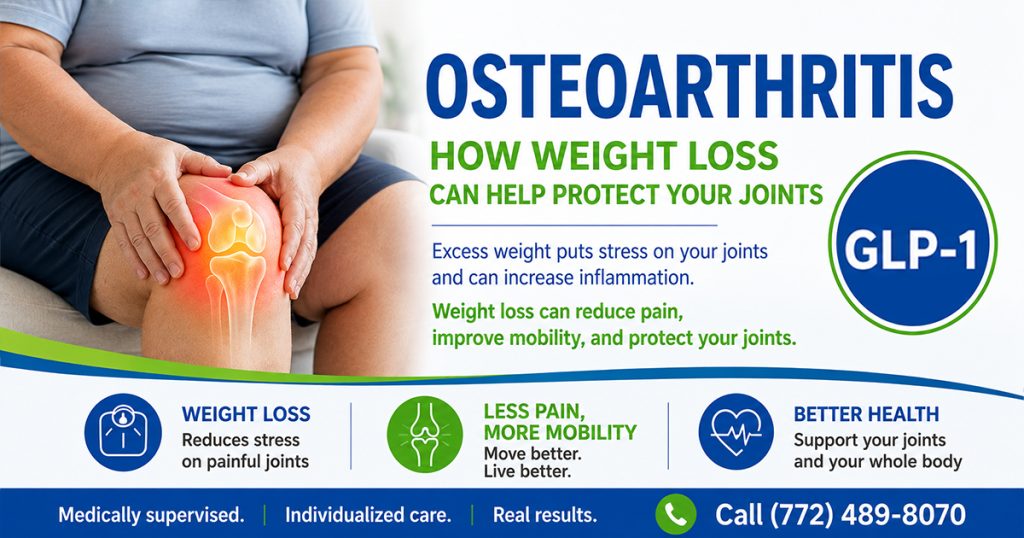
Osteoarthritis: How Weight Loss Can Help Protect Your Joints
Joint pain can make it difficult to stay active. Less activity can make weight management harder. Additional weight can then place even greater stress on painful joints. For many people living with osteoarthritis and obesity, this can become a difficult cycle.
Disclaimer: This article is for informational purposes only and is not intended to provide medical advice, diagnosis, or treatment. Please contact our medical providers at Coastal Primary Care to discuss your individual health needs and determine which treatment options may be appropriate for you.
Osteoarthritis (OA) is a chronic joint condition that causes pain, stiffness, swelling, and reduced mobility. While age, genetics, previous injuries, and repetitive stress can all contribute to osteoarthritis, excess body weight is one of the most important modifiable risk factors—particularly for osteoarthritis of the knees, hips, and ankles.
The encouraging news is that weight loss can be an important part of osteoarthritis management. For appropriate patients, medically supervised weight management—including the use of GLP-1 medications—may provide another tool for achieving meaningful, sustainable weight loss.
The relationship between obesity and osteoarthritis involves more than simply carrying additional pounds.
1. Extra Weight Means Extra Stress on Weight-Bearing Joints
Every day, the knees, hips, ankles, and lower back support the body's weight while we stand, walk, climb stairs, and perform everyday activities.
When body weight increases, the mechanical load placed on these joints also increases. Over time, this additional stress can contribute to damage of cartilage and other joint structures.
The National Institute of Diabetes and Digestive and Kidney Diseases (NIDDK) identifies obesity as a leading risk factor for osteoarthritis of the knees, hips, and ankles.
This also helps explain why even a moderate amount of weight loss may matter. A person does not necessarily have to reach an "ideal" body weight before experiencing health benefits.
2. Obesity Can Promote Inflammation
Mechanical pressure is only part of the story.
Body fat is biologically active tissue. Excess body fat can be associated with increased levels of inflammatory substances circulating in the body. According to NIDDK, this inflammation may contribute to joint inflammation and increase the risk of osteoarthritis.
This means obesity can potentially affect joint health in two important ways:
- increasing the physical load placed on joints, and
- contributing to an inflammatory environment within the body.
For someone already experiencing osteoarthritis, these factors may make pain and mobility problems even more challenging
The Osteoarthritis–Obesity Cycle
Osteoarthritis and obesity can reinforce one another.
A painful knee or hip may make walking, exercising, climbing stairs, or even completing routine daily activities difficult. As physical activity decreases, maintaining or losing weight can become harder.
Additional weight then places greater stress on the painful joint, potentially making activity even more difficult.
The cycle can look something like this:
Joint pain → less activity → weight gain or difficulty losing weight → greater joint stress → more difficulty moving
Breaking that cycle is an important goal of treatment.
How Weight Loss Can Help Osteoarthritis
For people who have overweight or obesity, losing weight can reduce stress on the knees, hips, and lower back and may also help decrease inflammation. NIDDK notes that people with osteoarthritis who lose weight may experience improvement in their symptoms.
Weight management can also provide benefits well beyond the joints. Obesity is associated with numerous chronic health conditions, including type 2 diabetes, high blood pressure, cardiovascular disease, sleep apnea, fatty liver disease, kidney disease, and other health problems.
Even modest weight loss can be meaningful. NIDDK notes that losing about 5% of starting body weight may be an appropriate initial goal for some people with overweight or obesity.
Exercise Still Matters
When joints hurt, avoiding exercise completely may seem logical. However, appropriate physical activity is an important part of osteoarthritis management.
NIDDK describes exercise as one of the best treatments for osteoarthritis because it can help decrease pain, improve flexibility, and improve mood.
The type and intensity of activity should be appropriate for the individual. For someone with significant knee or hip pain, a healthcare professional may recommend lower-impact activities rather than exercises that place excessive stress on the affected joint.
Weight management and physical activity can therefore work together: as weight decreases and movement becomes easier, some patients may find it more manageable to become active again.
Where GLP-1 Medications May Fit Into Weight Management
Lifestyle changes—including nutrition, physical activity, sleep, and behavioral changes—remain fundamental components of weight management. But obesity is a chronic disease, and lifestyle changes alone may not produce or maintain sufficient weight loss for everyone.
For appropriate patients, prescription weight-management medications may be considered as part of a comprehensive medical treatment plan.
GLP-1 receptor agonists are one class of medications that can be used for weight management in appropriately selected patients. These medications mimic hormones involved in appetite and satiety, helping some patients feel fuller longer, reduce hunger, and consume fewer calories.
Importantly, GLP-1 medications are not osteoarthritis cures and should not be presented as replacements for appropriate arthritis treatment. Their relevance to osteoarthritis is primarily connected to weight management—and researchers are now studying this relationship more closely.
Importantly, GLP-1 medications are not osteoarthritis cures and should not be presented as replacements for appropriate arthritis treatment. Their relevance to osteoarthritis is primarily connected to weight management—and researchers are now studying this relationship more closely.
What Research Shows About GLP-1 Treatment, Weight Loss, and Knee Osteoarthritis
An important randomized clinical trial published in the New England Journal of Medicine in 2024 studied 407 adults with obesity and moderate knee osteoarthritis accompanied by at least moderate pain.
Participants received either once-weekly semaglutide 2.4 mg or placebo for 68 weeks, along with counseling on physical activity and a reduced-calorie diet.
The results were notable.
Participants receiving semaglutide lost an average of 13.7% of their body weight, compared with 3.2% in the placebo group.
They also experienced a significantly greater reduction in osteoarthritis-related knee pain. On the 100-point WOMAC pain scale, the average improvement was 41.7 points with semaglutide versus 27.5 points with placebo. Physical-function scores also improved more in the semaglutide group.
These findings do not mean that everyone with osteoarthritis should take a GLP-1 medication. They do, however, provide important evidence that substantial medically managed weight loss can have meaningful effects on both weight and symptoms in certain people living with obesity and knee osteoarthritis.

A Medical Approach to Weight Loss
Weight management should not simply be about reaching a number on a scale. It should focus on improving overall health, mobility, and quality of life.
At Coastal Primary Care, our medically supervised weight-loss program takes an individualized approach. For patients who qualify, GLP-1 medications may be incorporated into a comprehensive weight-management plan under medical supervision.
Medical oversight is important because these medications are prescription treatments and are not appropriate for everyone. A healthcare professional should review a patient's health history, medications, weight-related conditions, potential contraindications, treatment goals, and possible side effects before determining whether GLP-1 therapy is appropriate.
For patients struggling with both obesity and osteoarthritis, successful weight management may mean more than seeing a lower number on the scale. It may mean less pressure on painful joints, improved mobility, greater ability to exercise, and better overall metabolic health.
Take Some Weight Off Your Joints
If excess weight is contributing to knee, hip, ankle, or lower-back discomfort, addressing obesity can be an important part of protecting your long-term health.
Coastal Primary Care offers a medically supervised weight-loss program, including GLP-1 treatment for appropriate patients.
Talk with our medical team to determine whether a medically supervised weight-management program may be right for you.
GLP-1 medications require medical evaluation and are not appropriate for every patient. Individual weight-loss and health outcomes vary. Osteoarthritis symptoms should be evaluated by a qualified healthcare professional.
Sources
New England Journal of Medicine — GLP-1 Receptor Agonists and Osteoarthritis
National Institute of Diabetes and Digestive and Kidney Diseases — Health Risks of Overweight & Obesity
NIDDK — Treatment for Overweight & Obesity
New England Journal of Medicine — Once-Weekly Semaglutide in Persons with Obesity and Knee Osteoarthritis
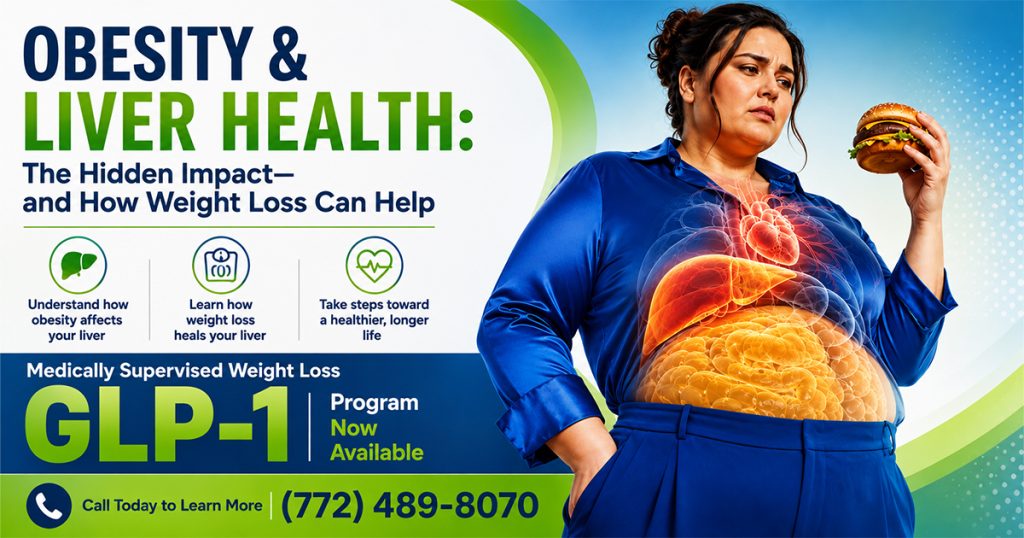
Obesity and Liver Health: Losing Weight Can Help
The liver is one of the most remarkable organs in the human body. It performs more than 500 vital functions every day, including filtering toxins from the blood, processing nutrients, regulating blood sugar, producing proteins essential for blood clotting, storing vitamins and minerals, and helping digest fats by producing bile. Because the liver works around the clock, maintaining its health is essential for overall well-being.
Unfortunately, obesity has become one of the leading causes of chronic liver disease in the United States. Today, more than one in three American adults lives with obesity, placing millions at increased risk for serious liver complications that often develop silently, without noticeable symptoms.
How Obesity Affects the Liver
Excess body fat, particularly fat stored around the abdomen, can lead to fat accumulation inside liver cells. This condition is known as Metabolic Dysfunction-Associated Steatotic Liver Disease (MASLD), formerly called nonalcoholic fatty liver disease (NAFLD).
n its early stages, fat buildup may cause few or no symptoms. However, if left untreated, the condition can progress to inflammation and liver cell damage, known as Metabolic Dysfunction-Associated Steatohepatitis (MASH) (formerly NASH). Over time, ongoing inflammation may lead to:
- Liver fibrosis (scarring)
- Cirrhosis
- Liver failure
- Increased risk of liver cancer (hepatocellular carcinoma)
In fact, MASLD is now one of the most common causes of chronic liver disease worldwide and a leading reason for liver transplantation.
Why the Liver Matters
Your liver is responsible for many life-sustaining functions, including:
- Filtering toxins, medications, and alcohol from the bloodstream
- Regulating blood glucose levels
- Processing cholesterol and fats
- Producing proteins needed for blood clotting
- Storing vitamins A, D, E, K, and B12
- Producing bile to aid digestion
- Supporting immune function
- Helping regulate hormones and metabolism
When the liver becomes overloaded with fat and inflammation, many of these critical functions become less efficient, affecting overall health.
Signs of Liver Disease
Early liver disease often develops without symptoms. As the condition progresses, individuals may experience:
- Fatigue
- Weakness
- Pain or discomfort in the upper right abdomen
- Unexplained weight loss
- Loss of appetite
- Yellowing of the skin or eyes (jaundice)
- Swelling of the legs or abdomen
- Easy bruising
Because symptoms often appear only after significant damage has occurred, regular medical evaluations are important for individuals with obesity, diabetes, high cholesterol, or metabolic syndrome.
The Good News: Weight Loss Can Improve Liver Health
Unlike many chronic diseases, fatty liver disease can often improve significantly with healthy weight loss.
Clinical studies have shown that:
- Losing 5% of body weight can reduce fat accumulation in the liver.
- Losing 7–10% of body weight may reduce liver inflammation.
- Losing 10% or more can improve liver fibrosis and, in some individuals, even reverse early liver damage.
Weight loss also helps improve:
- Insulin sensitivity
- Blood sugar control
- Cholesterol levels
- Blood pressure
- Overall cardiovascular health
Even modest, gradual weight loss can have meaningful benefits for liver function.
Healthy Lifestyle Changes That Support the Liver
Improving liver health involves long-term lifestyle changes, including:
- Eating a balanced diet rich in vegetables, fruits, lean protein, and whole grains
- Limiting added sugars and sugary beverages
- Reducing highly processed foods
- Engaging in regular physical activity
- Getting adequate sleep
- Avoiding excessive alcohol consumption
- Managing diabetes, cholesterol, and high blood pressure
Working with a healthcare provider can help develop a safe and personalized plan for sustainable weight loss.
Medical Weight Loss May Help
For some individuals, lifestyle changes alone may not be enough to achieve meaningful weight loss. Newer medications known as GLP-1 receptor agonists have shown significant promise in helping patients lose weight while improving metabolic health.
Clinical research has demonstrated that GLP-1 medications can:
- Promote significant and sustained weight loss
- Improve blood sugar control
- Reduce liver fat
- Improve liver inflammation in many patients with obesity and MASLD
- Lower the risk of cardiovascular disease
These medications work best when combined with healthy nutrition, regular exercise, and ongoing medical supervision.
Coastal Primary Care Can Help
If you are struggling with obesity or are concerned about your liver health, Coastal Primary Care is here to help.
Our medically supervised GLP-1 program includes comprehensive evaluations, individualized treatment plans, nutritional guidance, and lifestyle counseling. Our goal is to help patients achieve sustainable weight loss while improving overall health and reducing the risk of obesity-related diseases—including liver disease.
Healthy weight loss is about more than appearance—it is an investment in the long-term health of your liver, heart, and entire body.
Contact Coastal Primary Care today to learn whether our medically supervised GLP-1 weight loss program is right for you.
Sources
- American Association for the Study of Liver Diseases (AASLD). Practice Guidance on the Clinical Assessment and Management of Metabolic Dysfunction-Associated Steatotic Liver Disease (MASLD). Hepatology.
- American Liver Foundation. Fatty Liver Disease (MASLD/MASH). https://liverfoundation.org
- National Institute of Diabetes and Digestive and Kidney Diseases (NIDDK). Nonalcoholic Fatty Liver Disease. https://www.niddk.nih.gov
- Centers for Disease Control and Prevention (CDC). Adult Obesity Facts. https://www.cdc.gov/obesity
- Chalasani N, et al. The Diagnosis and Management of Nonalcoholic Fatty Liver Disease. Hepatology.
- Newsome PN, et al. A Placebo-Controlled Trial of Subcutaneous Semaglutide in Nonalcoholic Steatohepatitis. New England Journal of Medicine, 2021.
- American Diabetes Association. Standards of Care in Diabetes. Sections on obesity management and GLP-1 receptor agonists.