Understanding the connection between body weight, nighttime breathing, and better health.
Medical Disclaimer: This article is intended for educational and informational purposes only and does not constitute medical advice, diagnosis, or treatment. Consult Coastal Primary Care's medical providers or your healthcare professional to discuss your individual health needs and determine which treatment options may be appropriate for you.

A good night's sleep is essential for physical and mental well-being. Yet, millions of Americans struggle with a condition that repeatedly interrupts their breathing while they sleep—often without realizing it.
Obstructive sleep apnea (OSA) is a common sleep disorder that can leave you feeling exhausted, affect your concentration, and increase your risk of serious health problems.
For individuals living with excess weight, the risk of developing sleep apnea may be higher. The encouraging news is that even moderate weight loss can help improve symptoms and, in some cases, reduce the severity of the condition.
Understanding this connection is an important first step toward better sleep and long-term health.
Obstructive sleep apnea occurs when the muscles supporting the soft tissues in the throat relax during sleep, causing the upper airway to narrow or temporarily close.
These interruptions can happen repeatedly throughout the night, reducing oxygen levels and briefly waking the brain to restore normal breathing.
Many people are unaware that these episodes are occurring.
Common signs and symptoms include:
Not everyone who snores has sleep apnea, and not everyone with sleep apnea snores. A medical evaluation and sleep study can help establish a diagnosis.
Body weight is one of several factors that can influence the development and severity of obstructive sleep apnea.
Excess fatty tissue around the neck and upper airway can increase pressure on the throat, making it more likely to collapse during sleep.
Fat accumulation around the abdomen may also affect lung volume and breathing mechanics, potentially making the airway less stable.
The relationship can become a difficult cycle:
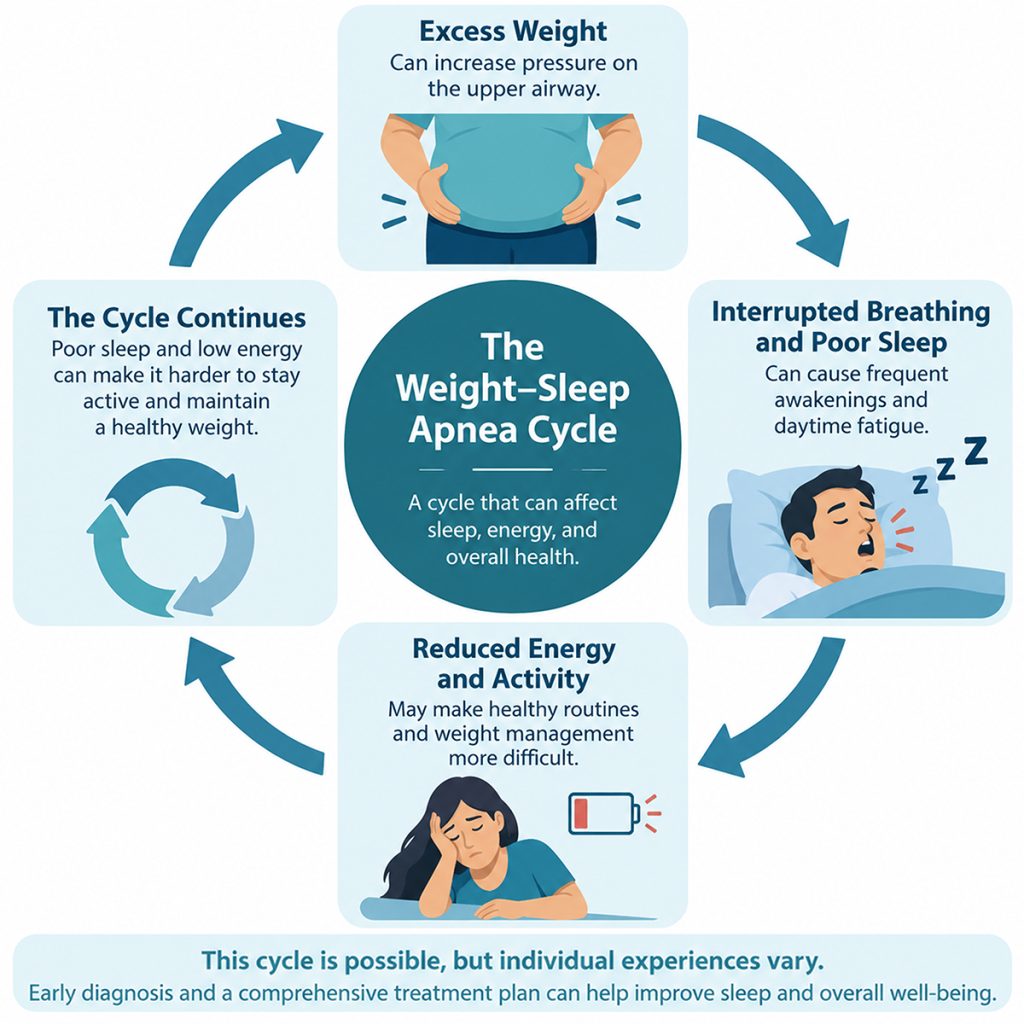
Importantly, sleep apnea also affects individuals who are not overweight. Genetics, airway anatomy, age, and other medical factors can contribute to the condition.
Untreated obstructive sleep apnea can affect much more than sleep quality.
Repeated drops in oxygen levels and disrupted sleep place additional stress on the cardiovascular system and may contribute to several health conditions.
These include high blood pressure, heart disease, stroke, abnormal heart rhythms, and metabolic problems such as type 2 diabetes.
Excessive daytime sleepiness can also increase the risk of motor vehicle accidents and workplace injuries.
Early diagnosis and appropriate treatment can help reduce symptoms and improve quality of life.
Weight loss can be an important part of managing obstructive sleep apnea, particularly when excess weight contributes to airway narrowing.
Research supported by the National Institutes of Health has found that weight loss can reduce the severity of sleep apnea. However, the amount of improvement varies from person to person.
Potential benefits include:
1. Fewer breathing interruptions
Reducing fatty tissue around the upper airway may decrease its tendency to collapse during sleep, potentially reducing the frequency of breathing interruptions.
2. Better oxygen levels
Improved breathing during sleep may reduce episodes of low blood oxygen, helping the body maintain more stable oxygen levels overnight.
3. Improved sleep quality
When breathing interruptions decrease, sleep may become less fragmented, potentially allowing individuals to wake feeling more refreshed.
4. More daytime energy
Better sleep may help reduce daytime fatigue, improve concentration, and make it easier to participate in physical activity.
5. Additional health benefits
Weight management can also support improvements in blood pressure, blood sugar regulation, and overall cardiovascular health.
Even modest weight loss may improve sleep apnea symptoms. However, weight loss does not guarantee that sleep apnea will disappear.
For some individuals, achieving and maintaining weight loss through lifestyle changes alone can be challenging.
GLP-1 receptor agonists are medications that mimic a naturally occurring hormone involved in appetite regulation and blood sugar control. Certain medications in this category can help eligible patients reduce hunger, feel satisfied sooner, and achieve meaningful weight loss.
A significant development occurred on December 20, 2024, when the U.S. Food and Drug Administration approved tirzepatide, for treating moderate-to-severe obstructive sleep apnea in adults with obesity, alongside a reduced-calorie diet and increased physical activity.
Tirzepatide acts on both GLP-1 and GIP hormone receptors.
In two clinical studies involving 469 adults without type 2 diabetes, participants receiving tirzepatide experienced significant reductions in breathing interruptions and greater weight loss compared with those receiving a placebo after 52 weeks.
These findings demonstrate the potential role of medically supervised weight management in treating certain patients with sleep apnea.
Important: Not all GLP-1 medications are FDA-approved specifically for sleep apnea. Medication eligibility, potential side effects, and appropriate treatment must be evaluated individually by a qualified healthcare provider.
Not necessarily.
Continuous positive airway pressure (CPAP) therapy remains an established treatment for obstructive sleep apnea. It works by delivering gentle air pressure through a mask to help keep the airway open during sleep.
Although weight loss may reduce sleep apnea severity, some individuals continue to experience breathing interruptions even after substantial weight reduction.
Patients should never discontinue CPAP therapy or adjust their prescribed settings without consulting their healthcare provider.
A follow-up sleep study may be recommended after significant weight loss to determine whether treatment adjustments are appropriate.
At Coastal Primary Care, we understand that weight management is about much more than a number on the scale. It is about improving your health, restoring your energy, and helping you feel better in your everyday life.
Our medically supervised GLP-1 weight management program provides individualized support for eligible patients who want to achieve sustainable weight loss.
For individuals living with excess weight and obstructive sleep apnea, medically guided weight management may be an important component of a comprehensive treatment plan.
Our healthcare providers can evaluate your medical history, discuss appropriate weight management options, and help you establish realistic goals based on your individual health needs.
If you experience persistent snoring, daytime exhaustion, or interrupted breathing during sleep, speak with a healthcare professional about evaluation for sleep apnea.
Better sleep begins with better health—and every positive step matters.

National Heart, Lung, and Blood Institute — Sleep Apnea: Causes and Risk Factors.
National Heart, Lung, and Blood Institute — Sleep Apnea: Treatment.
National Institutes of Health — Sleep Apnea Research .
U.S. Food and Drug Administration — FDA Approves First Medication for Obstructive Sleep Apnea, December 20, 2024 .