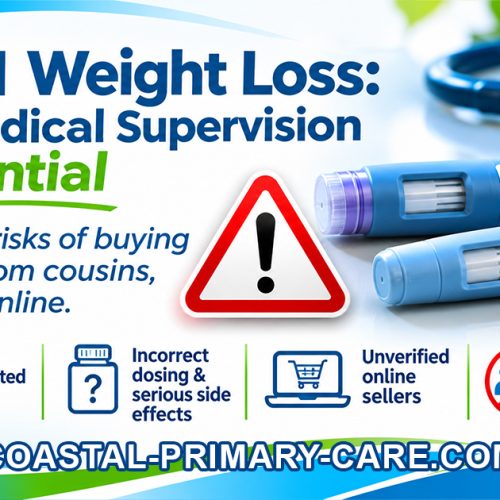
GLP-1 weight-loss injections are prescription drugs, not ordinary diet supplements. They require medical supervision. Learn the risks of buying semaglutide...
Read More
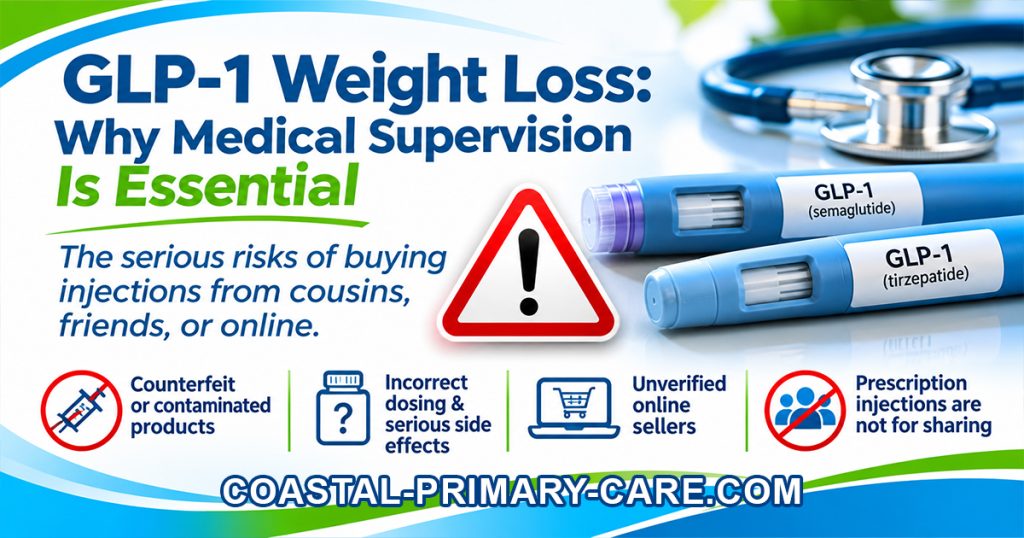
GLP-1 medications have transformed medical weight management, but their growing popularity has also created a troubling trend: people obtaining injectable weight-loss drugs from friends, relatives, social media sellers, and questionable online sources without medical supervision. What appears to be an inexpensive shortcut could come at a serious cost to your health.
Medications such as semaglutide and tirzepatide have changed the way healthcare professionals approach obesity and weight management. By influencing hormones involved in appetite regulation, blood sugar control, and digestion, these medications can help eligible patients lose significant weight when combined with appropriate nutrition, physical activity, and ongoing medical care.
Semaglutide acts on the glucagon-like peptide-1 (GLP-1) receptor, while tirzepatide acts on both GLP-1 and glucose-dependent insulinotropic polypeptide (GIP) receptors.
For many patients, these treatments offer benefits beyond weight reduction, including improvements in certain metabolic risk factors. Some products also have FDA-approved indications for specific conditions beyond weight management.
However, GLP-1 medications are prescription drugs, not ordinary diet supplements. Their effectiveness does not eliminate their risks, and successful treatment involves much more than administering a weekly injection.
As demand has increased, so has the temptation to obtain these medications outside legitimate medical channels.
A cousin may offer a few unused injections. A friend may recommend splitting the cost of a vial. Someone on social media may advertise weight-loss injections at a fraction of pharmacy prices. An online seller may promise the same results without requiring a prescription.
These arrangements may sound convenient, but they introduce risks that patients often do not recognize until something goes wrong.
Imagine hearing that a cousin lost 30 pounds using semaglutide. Impressed by the results, you ask where to obtain it. Your cousin offers to share some medication or sell you a few injections.
What could possibly go wrong?
Quite a lot.
Prescription medications are selected for an individual based on their medical history, current health, other medications, and treatment goals.
A dose that is appropriate for your cousin may be completely inappropriate for you.
GLP-1 medications are generally initiated at lower doses and increased gradually according to the specific product's prescribing instructions and the patient's tolerance.
Starting at someone else's maintenance dose can cause severe nausea, vomiting, diarrhea, dehydration, and other complications.
Additionally, you may have medical conditions or take medications that require additional precautions.
For example, certain GLP-1 and GIP/GLP-1 medications are contraindicated in people with a personal or family history of medullary thyroid carcinoma or Multiple Endocrine Neoplasia syndrome type 2 (MEN2).
Sharing prescription injections is not a harmless favor. It bypasses the medical evaluation intended to protect the patient.
The internet has made obtaining weight-loss products easier than ever. Unfortunately, not every website advertising semaglutide or tirzepatide is a legitimate pharmacy.
Some sellers market products labeled as "research peptides," "generic Ozempic," or "weight-loss injections" without providing reliable information about their origin, ingredients, or manufacturing standards.
Potential dangers include:
The FDA has warned consumers about illegally marketed GLP-1 products, fraudulent products, and adverse events associated with dosing errors involving compounded injectable semaglutide.
A professional-looking website, attractive packaging, or glowing customer reviews do not guarantee that a medication is genuine or safe.
Even a website that claims to have a physician available should be evaluated carefully. A legitimate prescription requires an appropriate medical assessment, and medications should be dispensed through a properly licensed pharmacy.
Another source of confusion involves compounded semaglutide and tirzepatide.
Compounding is a legitimate pharmacy practice that can meet certain individualized medical needs when performed in accordance with applicable federal and state laws.
However, compounded medications are not FDA-approved. Unlike FDA-approved products, they do not undergo FDA premarket review for safety, effectiveness, and quality.
The FDA has specifically warned about dosing errors associated with compounded injectable semaglutide, including cases requiring hospitalization.
These errors can occur when patients misunderstand the difference between milligrams, milliliters, and syringe units, particularly when medication concentrations vary between products.
The FDA has also raised concerns about certain salt forms of semaglutide, including semaglutide sodium and semaglutide acetate, which differ from the active ingredient used in FDA-approved semaglutide medications.
Compounded medications should not be confused with counterfeit products, but neither should they be assumed to be interchangeable with FDA-approved medications.
Patients should never purchase a compounded GLP-1 injection from an informal seller or attempt to prepare injectable medication themselves.
When compounding is medically necessary and legally permitted, treatment should involve an appropriately licensed prescriber and pharmacy.
Although many patients tolerate GLP-1 medications well, side effects can occur, particularly when starting treatment or increasing doses.
Common side effects include nausea, vomiting, diarrhea, constipation, and abdominal discomfort.
More serious complications may include:
Pancreatitis: Severe, persistent abdominal pain, sometimes radiating to the back, may indicate inflammation of the pancreas and requires immediate medical evaluation.
Gallbladder problems: Rapid weight loss and certain GLP-1 treatments may be associated with gallstones or gallbladder inflammation.
Dehydration and kidney injury: Persistent vomiting or diarrhea can cause substantial fluid loss, potentially leading to acute kidney injury.
Hypoglycemia: The risk of dangerously low blood sugar increases when certain GLP-1 medications are used alongside insulin or medications such as sulfonylureas.
Severe gastrointestinal reactions: Because these medications slow gastric emptying, patients may experience significant digestive symptoms. Some products are not recommended for patients with severe gastroparesis.
Allergic reactions: Serious hypersensitivity reactions, although uncommon, can occur.
Medical supervision helps identify potential problems early and determine whether treatment should be adjusted, temporarily interrupted, or discontinued.
A person administering injections purchased from a friend or online seller may not know which symptoms are expected, which are dangerous, or when to seek medical attention.
One of the most dangerous misconceptions about GLP-1 treatment is that a higher dose will automatically produce faster or better weight loss.
That is not how responsible medical weight management works.
The appropriate dose depends on the specific medication, its approved dosing schedule, the patient's response, and tolerability.
For example, semaglutide and tirzepatide have different dosing schedules and are not interchangeable milligram for milligram.
Medical professionals typically begin with a low dose and increase it gradually as directed by the product's prescribing information.
This approach helps reduce gastrointestinal side effects while allowing clinicians to evaluate the patient's response.
Taking too much medication or increasing the dose too quickly can lead to significant adverse reactions.
Patients who obtain injections from informal sources may receive incomplete instructions or mistakenly assume that all injectable weight-loss medications follow the same dosing schedule.
A syringe marked with a particular number of units does not necessarily contain the same amount of medication as another syringe, especially when vial concentrations differ.
That misunderstanding alone can result in a serious overdose.
Successful medical weight management involves treating the whole patient, not simply prescribing a medication that suppresses appetite.
Before starting GLP-1 treatment, a healthcare professional should evaluate factors such as:
Ongoing monitoring is equally important.
Patients losing weight rapidly may need guidance to maintain adequate protein intake, preserve muscle mass, avoid nutritional deficiencies, and remain properly hydrated.
Resistance exercise and appropriate physical activity can help protect muscle mass during weight reduction.
Healthcare professionals can also monitor medication tolerance, assess progress, and adjust treatment when needed.
For patients with diabetes, medication changes may be necessary as blood sugar levels improve.
Patients who become pregnant or plan pregnancy require special consideration because weight-loss medications may need to be discontinued according to product-specific recommendations.
The goal should not simply be to lose pounds. It should be to improve health while minimizing avoidable risks.
Cost is one of the biggest reasons people seek GLP-1 medications from unofficial sources.
FDA-approved weight-loss medications can be expensive, and insurance coverage varies considerably.
When someone offers injections at a dramatically reduced price, the financial savings may appear irresistible.
But what happens if the product is counterfeit, contaminated, improperly stored, or incorrectly dosed?
An emergency department visit, hospitalization, or treatment for a serious complication can cost far more than the original medication.
There is also the risk of paying for a product that contains little or none of the advertised active ingredient.
A lower price does not necessarily represent better value when the safety and authenticity of the medication cannot be established.
Patients concerned about affordability should discuss legitimate treatment options, insurance coverage, manufacturer assistance programs when eligible, and alternative weight-management strategies with their healthcare provider.
Patients should be particularly cautious when a seller:
An important reminder: Never share injection pens or needles, even if the needle is changed. Sharing can expose individuals to bloodborne infections.
Patients should also verify that online pharmacies are appropriately licensed and require valid prescriptions.
If you have obtained a GLP-1 injection from a friend, relative, social media seller, or questionable website, do not assume the product is safe simply because someone else used it without problems.
Before taking another dose, speak with a licensed healthcare professional or pharmacist.
If possible, retain the original packaging and information about the product, including its name, concentration, source, and any doses already administered. This information can help a clinician assess potential risks.
If you suspect an overdose, contact Poison Control at 1-800-222-1222 in the United States for immediate guidance.
Seek emergency medical care for severe or persistent abdominal pain, repeated vomiting with inability to keep fluids down, fainting, confusion, seizures, difficulty breathing, or signs of a serious allergic reaction.
Do not wait for symptoms to become life-threatening before seeking help.
GLP-1 medications have opened important new possibilities for patients struggling with obesity and weight-related medical conditions.
But their popularity should not obscure a fundamental principle of healthcare: effective treatment must also be appropriate and safe for the individual receiving it.
A medication that works well for your cousin, friend, coworker, or favorite social media personality may not be the right medication for you.
And a cheap injection purchased online may not contain what the seller claims.
Medical supervision provides more than a prescription. It offers individualized assessment, appropriate dosing, monitoring for complications, nutritional guidance, and ongoing support.
The objective is not simply rapid weight loss. It is lasting improvement in health, quality of life, and overall well-being.
At Coastal Primary Care, we believe weight management should be approached with medical knowledge, individualized attention, and a commitment to patient safety.
If you are considering semaglutide, tirzepatide, or another medical weight-management treatment, schedule a consultation to discuss your health history, treatment options, potential risks, and realistic goals.
Do not gamble with your health by purchasing questionable injections from friends, relatives, or unverified online sellers.
The right weight-loss plan begins with the right medical guidance.
Coastal Primary Care — Personalized Care for a Healthier You.
This article is provided for educational and informational purposes only and does not constitute individualized medical advice, diagnosis, or treatment. GLP-1 and GIP/GLP-1 medications are prescription drugs with potential contraindications, warnings, and adverse effects. Not every patient is an appropriate candidate. Compounded drugs are not FDA-approved, and their use is subject to applicable legal and clinical requirements. Always consult a qualified healthcare professional before beginning, changing, or discontinuing medication.